Search This Blog

Showing posts with label curriculum. Show all posts

Saturday, June 4, 2016

Product Spotlight- Green Box Kids Book 1: Sharing


Sharing is one of the most important skills we try to teach our students, and it’s something they’re going to need to use every day for the rest of their lives. Even as adults, sharing is something we do all the time, so much so that it’s jarring when someone doesn’t share; how many times have you waited for a machine at the gym or an electrical outlet at a coffee shop and been absolutely bewildered when the other person using them failed to share? We know sharing is tough for all kids, and it can be even more difficult to help kids with behavioral and developmental disabilities understand all of the various social elements that comprise good sharing. We’ve created another social skills training curriculum book to address those very difficulties in a format that is both fun and engaging for both you and your learners. We’ve talked at length about another book in the Green Box Kids series, Compromise, and we’ve brought the same commitment to excellence and accessibility to Sharing, now available on Teachers Pay Teachers.


Sharing has the same format as Compromise: discussion questions before and after each of the three comics in the book to boost critical thinking about the topic, plus supplemental activities that expand upon those questions. In addition to fostering discussion about the basics of sharing, this book goes into situations when sharing may not be appropriate by asking learners questions like these:


Our focus here is not just to help learners understand what sharing is, but why sharing is important to their lives. What makes Green Box Kids: Sharing different from other curriculum books on Sharing is that it encourages learners to examine sharing from multiple perspectives. Additionally, although each social dilemma presented in the comics has an example of a resolution, the book also encourages the readers to think of their own solutions. For example, the first comic in the book sees Tito and Lucy playing an active game of soccer, but Tito has forgotten his water bottle. Before showing the readers what the Green Box Kids do to fix the problem, there’s an opportunity for the reader to draw what they think would be a good way to help Tito:


Instead of just telling readers what the best answer is, this book encourages them to think for themselves and consider the options their peers came up with.


Our social skills training curriculum books are more than just social group activities, they’re the building blocks of happy, sociable adults. When you buy our book on Sharing, you’re getting comics along with improved social skills and better, more productive social group sessions. As with all of our books, the material in Green Box Kids: Sharing are the product of years of working with kids who have autism spectrum disorders and other behavioral or developmental disorders, as well as years of training and education. More importantly, when you buy our books you’re buying the product of our sincere desire for kids on the spectrum to have a better quality of life and an easier time adjusting to social situations outside of supervised social group. Our kids love Green Box Kids, and we’re confident that yours will too.

Thursday, June 2, 2016

Setting Goals for Social Skills Group


We’ve talked before about why individualizing goals for the kids in your group is important, but what exactly does it mean to set a goal?  Every goal should have a sheet with the current target, the purpose of the program, the procedures of implementing the program, how to collect data on the target, and what constitutes as mastery. Here’s a basic rundown of the elements that go into setting goals for autism spectrum kids in a social skills play group:

Purpose

n  Why are you setting this particular goal? Which behaviors are you looking to increase or decrease? When setting goals, think about whether or not those goals will improve the individual’s life. If the answer is no, it’s not a good goal to set. We’re always looking for social validity, so for example: your 5 year old student keeps making jokes about poop. You think poop jokes are gross, but you wouldn’t necessarily want to write a program to decrease the jokes, because that’s typical behavior for a 5 year old, and other typical students are also making similar jokes. We’re not looking for cookie-cutter perfect kids, we’re helping kids interact with other kids in socially acceptable ways. Knowing which skills your kids are working on and why they’re working on them is important for understanding how best to implement the program’s procedures. Often times the social skills group goals set for your kids will be related to goals set for one-on-one therapy sessions. For instance, let’s say a student’s home therapist is working on increasing wh- questions. The same program may be tweaked to fit social group by asking peers to ask the student wh- during group to track generalization.

Procedures for Implementation

n  What steps go into this goal? For instance, if you’re working on a tacting program (labelling objects and people based on visual cues) using picture cards, your procedure might look like this:

                                                                                                 i.    Take out picture card
                                                                                                ii.    Hold up picture card of preferred item
                                                                                              iii.    If child responds appropriately, put a correct trial mark in trial box. If child responds inappropriately or does not respond, give correct answer and return to step two.

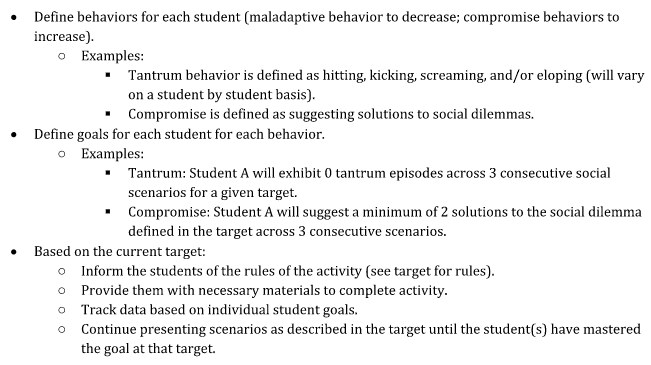
That’s just one example, and procedures can (and almost always will) have many more steps than that. Knowing your procedure is important because following the same procedure across different environments and therapists, teachers, parents, and caregivers is the only way to get reliable and accurate data across the board. This is especially important to note when individualizing goals for social group, as we’ve discussed here. Here’s what an example procedure might look like:


As you can see, it’s specific and doesn’t leave room for too much interpretation, which is important. Everyone implementing the program should be able to quickly read and understand the procedures to keep them consistent.

Collecting Data

n  There’s an entire post on collecting data during social group here, but the basics of it are as follows. You’ll most likely have a few group-appropriate goals to focus on with a description of their procedures, and then a row of small square boxes in which to mark whether the target behavior was completed or not, with each box representing one trial. If a correct trial occurred, you would record a +. If a prompted trial occurred, you would mark a P. This is called trial-by-trial data collection, and it’s what’s most often used during social skills groups with anecdotal data (general notes) kept as well. Keeping accurate, consistent data is important for several reasons, but above all data will tell you when a target has been mastered so you can move on to the next target.

Mastery criteria

n  The idea behind mastery criteria is to set a level of performance that lets the instructor know the student is ready for the difficult of the target to increase. Mastery should be a certain percentage above the child’s current performance. Mastery criteria are set somewhere between 80% and 100% correct performance across multiple sessions or days. The high level of accuracy is included because the skill must be established before moving on to the next target. Including a time component or multiple session component to the mastery ensures that phenomenal performance on a given day is not a fluke.

Targets


n  Finally we have targets, which are different levels of program mastery. Many programs will have similar procedures for several targets. For example, let’s say that Barry’s target is 1 peer response (responding when a friend asks a question or says hello) with one prompt, with the program purpose being increased intraverbals. Once he’s mastered that target, his next target in this program might be 1 peer response with no prompts. Targets build off of each other to increase or decrease the target behavior. In the ABA world this is known as shaping, which we’ll talk about more in a later blog. All of these elements put together form a solid program that can be used to make social group a better, more efficient process!

Thursday, May 26, 2016

Product Spotlight (part 2)- Green Box Kids Book 2: Compromise


Welcome to part 2 of our spotlight on Green Box Kids Book 2: Compromise! We’re going to go over how to most effectively use the book with your learners, and why you should go over to Teachers Pay Teachers and download it.


      Compromise is one of the most important skills for kids to learn; it's also one of the most difficult to teach. It can be tough for kids to put themselves in other people's shoes, especially when compromise means not getting to do a preferred activity. Kids can struggle to understand why compromise is important. Take the following example question from the book:


This is a pretty common situation, and it can be difficult to explain to your kids that neither one of them is more entitled to the red token than the other. No matter who gets to use the token, one or more kids is not getting something they wanted without fully understanding why. We know how frustrating it can be as an educator or instructor to know exactly what skill you need to get across to your learner, but not how to help them understand it.


We found solutions to these dilemmas through years of teaching social skills like compromise to kids with autism spectrum disorder and other developmental and behavioral disorders. The questions and activities in this book are the result of extensive experience and research. The material is easy to read, with large fonts and contrasting font and background colors. It’s also easy to follow, with plain, conversational language. This book is meant to make teaching compromise easier and broaden your learner's understanding of why compromise is crucial, all while teaching your learners the importance of taking other people's feelings into consideration when making decisions. When using this book, your learners will be engaged throughout and will have to think and work together to complete the activities. Each activity and comic includes examples and scenarios that are applicable to your learners’ lives and promote generalization across environments. By using kids in our comics, we relate the situations the Green Box Kids face to your learners’ real lives. Whether you’re a BCBA, a Registered Behavior Technician, a special education teacher, or a parent, this book is easy to use, and the program and data sheets in the back are a great place to start individualizing goals for your learners.

We’ve all had to try to learn something or complete a task that we couldn’t get into; trying to engage in material when you just don’t find interesting or applicable to your life can feel like an impossible task. Green Box Kids believes that social skills training doesn’t have to feel like a chore. Green Box Kids Books make learning fun and emphasize why learning social skills is important to your learners instead of just what social skills are. We engage kids on the topics that matter to them because we think you shouldn’t have to compromise on fun or learning.     

Wednesday, May 25, 2016

Product Spotlight (part 1)- Green Box Kids Book 2: Compromise


              Today we’re going to take a look at one of the awesome products we have available for purchase on Teachers Pay Teachers! Compromise is the second installment of the Green Box Kids series of comics-based social skill development activity books for children with an autism spectrum disorder, ADHD, a developmental disorder, and other behavior disorders, developed by behavior analysts for special education teachers and specialists. In part 1 of today’s blog we’ll go over the structure of the book, then in part 2 we’ll go over how to use this book with students!

they are awfully cute, aren't they? the illustrator is amazing, she's so talented


            Green Box Kids Book 2: Compromise starts with a few pages of introduction to the series and the characters before going over some guidelines for how to best use the activities inside with your student or students before getting into the activities. Every book has 3 different thematically-appropriate comics with matching pre-comic questions and supplemental activities for you to work through with your learner. We’re going to over just one of the comics titled The Pizza right now, but the rest of them are available through downloading the book on Teachers Pay Teachers.


            Before we look at the first comic, there are a few questions to get your learner thinking about compromise. They work great as discussion questions for both groups of learners working through the activities together or one-on-one with an individual learner.


            After the introduction questions, learners read over the comic, which sees Green Box Kids Tito, Lisa, and Richard trying to decide what toppings to put on their pizza. Tito adds lots of spices and onions to the pizza, even though Lisa and Richard tell him that they don’t like pizza with spices or onions. The comic ends with a social dilemma for your learners to work through: why Lisa and Richard are unhappy that Tito put spices and onions on the pizza? The book breaks down the comic piece by piece to help your learner analyze the characters’ facial expressions, body language, and words to understand what the dilemma is.


Once they’ve finished breaking the comic down, there are additional questions to encourage critical thinking and discussion among readers, analyzing each character’s actions and motivations. There are also supplemental activities that readers can do together to practice the compromise skills they’ve been discussing.


Finally, readers are encouraged to draw what they think Tito, Richard, and Lisa should do to resolve their dilemma with compromise before showing what one correct response in the comic could be. The book makes sure to acknowledge that there are lots of different ways the Green Box Kids could have compromised.


The book itself ends with behavior extension material for educators and instructors, including a compromise program that can be individualized for each learner and example data sheets that can be used in one-on-one or group settings.


We’ll go more into how and why to use these materials in part two, but if you’d like to see the full book right now, you can download it here at Teachers Pay Teachers!