Search This Blog

Showing posts with label social group. Show all posts

Friday, June 10, 2016

What is Task Analysis?


Have you ever thought about how many little steps go into things you do every day? This morning I brushed my teeth, braided my hair, and made coffee. The amount of smaller steps that go into each of those tasks is astounding. If I had written down every single action I took to brush my teeth or braid my hair, I would have written a task analysis for myself that I could then use to teach someone else how to brush their teeth or braid their hair. For kids on the autism spectrum who may have difficulties with processing or executive function, tasks that seem simple to us like brushing teeth can be overwhelming. Breaking those tasks down into component steps, much like you might make a to-do list for a multi-part project, can be a huge help for kids struggling with both social and non-social situations.

Part of an example of task analysis for tooth brushing. As you can see, it breaks brushing teeth down into tiny, manageable parts

         A task analysis breaks a complex task like brushing teeth or greeting a peer down into its most basic steps. Task analyses are completed because there are a variety of steps that go into completing a complex task, and to teach that task you need to know that your learner can complete each step. Additionally, some tasks need to be completed in order; for example, brushing your teeth with a dry toothbrush then squeezing toothpaste onto that toothbrush doesn’t work. This is also valuable because you can reinforce each step as you teach it in a process called chaining, which can be done forward or backward. In forward chaining, you start by teaching the first of the steps you wrote down in your task analysis. This can be useful if your learner already has some or most of the requisite skills needed to complete the task. For instance, if tying shoes is your task and your learner can already put their feet in the shoes and grab the shoelaces, forward chaining might be the way to go. Backward chaining starts by teaching and reinforcing the very last step of a task, then the penultimate step, and so on. This can be good because you’re always reinforcing the final outcome of the task, so no matter what step you’re currently teaching, your learner is always completing the task independently. Breaking down your task and teaching through chaining allows for greater access to reinforcement throughout the teaching process, which can be especially useful in social situations, For more information on reinforcement in social situations, look out for our upcoming post. The degree to which you simplify the steps depends on your learner. For example, if the task is “washing hands” some learners will need “turn on water, put on soap, scrub, turn off water,” while others will need a more detailed list. Sometimes pictures can also be helpful in teaching each step, like adding a picture of your learner’s toothbrush and faucet handle to their list of steps. Knowing what will be most helpful to your learner is crucial to making a useful task analysis.

Task analyses can also be completed for social skills group. First, a social skills assessment needs to be done. Things like ABLLS and VBMAPP as administered by a professional behavior analyst can be used to assess the learner’s social skills. Once you’ve selected a goal, then you can break it down. For example, we find that during issues of dispute, one of our learners typically tantrums rather than selecting a compromise for a solution. Now we have our goal and it’s time to break it down. Refer back to the hand washing example-the component steps will be based on the learner’s needs. An example of component steps for compromise would be identifying functional compromise solutions when presented with a social dilemma with a peer. In order to identify those solutions and break that process down into steps, keep in your learner’s goals and program targets. For more information on setting goals for social group, refer back to our blog post here. One example of a situation where a social task analysis for compromise might be useful might be a social skills group science project. All of the learners in the group need to compromise on the topic of the science project, which means no one is going to get to do exactly what they want to do. Luckily, since this hypothetical science project takes place in a social skills group, each kid can have a task analysis done for compromise with adults helping to facilitate the interactions and prompt the different steps of the task analysis. Once the learners have practiced using their task analysis during a contrived situation like social skills group, they can generalize to natural situations like hanging out with friends or working on a project in class, fading out adult prompting to boost independent social interactions.


Task analysis is important because while some tasks might seem second nature to neurotypical people, they can be daunting for people on the autism spectrum. Interacting with other people, even before morning coffee, is simple for neurotypical people because we know the various steps that apply to each social situation, and it can be difficult to try to explain those steps to someone else. Task analyses break these social situations down into the steps we already go through and make them accessible to people on the autism spectrum instead of just expecting them to do the things their typical peers do. We all make task analyses for ourselves, we just usually call them to-do lists or have tasks mentally broken down in our heads. Task analyses are just versions of these lists, modified to best help our learners navigate the world.

Thursday, June 2, 2016

Setting Goals for Social Skills Group


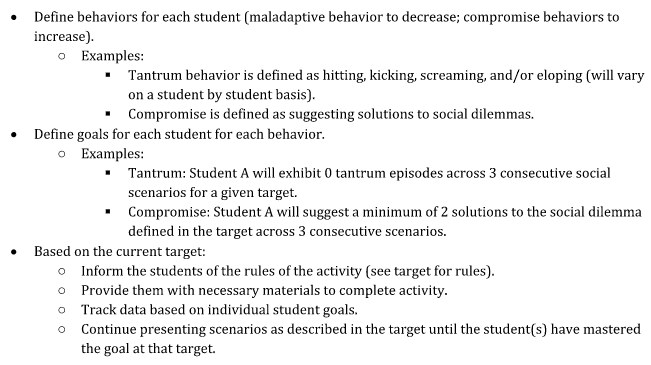
We’ve talked before about why individualizing goals for the kids in your group is important, but what exactly does it mean to set a goal?  Every goal should have a sheet with the current target, the purpose of the program, the procedures of implementing the program, how to collect data on the target, and what constitutes as mastery. Here’s a basic rundown of the elements that go into setting goals for autism spectrum kids in a social skills play group:

Purpose

n  Why are you setting this particular goal? Which behaviors are you looking to increase or decrease? When setting goals, think about whether or not those goals will improve the individual’s life. If the answer is no, it’s not a good goal to set. We’re always looking for social validity, so for example: your 5 year old student keeps making jokes about poop. You think poop jokes are gross, but you wouldn’t necessarily want to write a program to decrease the jokes, because that’s typical behavior for a 5 year old, and other typical students are also making similar jokes. We’re not looking for cookie-cutter perfect kids, we’re helping kids interact with other kids in socially acceptable ways. Knowing which skills your kids are working on and why they’re working on them is important for understanding how best to implement the program’s procedures. Often times the social skills group goals set for your kids will be related to goals set for one-on-one therapy sessions. For instance, let’s say a student’s home therapist is working on increasing wh- questions. The same program may be tweaked to fit social group by asking peers to ask the student wh- during group to track generalization.

Procedures for Implementation

n  What steps go into this goal? For instance, if you’re working on a tacting program (labelling objects and people based on visual cues) using picture cards, your procedure might look like this:

                                                                                                 i.    Take out picture card
                                                                                                ii.    Hold up picture card of preferred item
                                                                                              iii.    If child responds appropriately, put a correct trial mark in trial box. If child responds inappropriately or does not respond, give correct answer and return to step two.

That’s just one example, and procedures can (and almost always will) have many more steps than that. Knowing your procedure is important because following the same procedure across different environments and therapists, teachers, parents, and caregivers is the only way to get reliable and accurate data across the board. This is especially important to note when individualizing goals for social group, as we’ve discussed here. Here’s what an example procedure might look like:


As you can see, it’s specific and doesn’t leave room for too much interpretation, which is important. Everyone implementing the program should be able to quickly read and understand the procedures to keep them consistent.

Collecting Data

n  There’s an entire post on collecting data during social group here, but the basics of it are as follows. You’ll most likely have a few group-appropriate goals to focus on with a description of their procedures, and then a row of small square boxes in which to mark whether the target behavior was completed or not, with each box representing one trial. If a correct trial occurred, you would record a +. If a prompted trial occurred, you would mark a P. This is called trial-by-trial data collection, and it’s what’s most often used during social skills groups with anecdotal data (general notes) kept as well. Keeping accurate, consistent data is important for several reasons, but above all data will tell you when a target has been mastered so you can move on to the next target.

Mastery criteria

n  The idea behind mastery criteria is to set a level of performance that lets the instructor know the student is ready for the difficult of the target to increase. Mastery should be a certain percentage above the child’s current performance. Mastery criteria are set somewhere between 80% and 100% correct performance across multiple sessions or days. The high level of accuracy is included because the skill must be established before moving on to the next target. Including a time component or multiple session component to the mastery ensures that phenomenal performance on a given day is not a fluke.

Targets


n  Finally we have targets, which are different levels of program mastery. Many programs will have similar procedures for several targets. For example, let’s say that Barry’s target is 1 peer response (responding when a friend asks a question or says hello) with one prompt, with the program purpose being increased intraverbals. Once he’s mastered that target, his next target in this program might be 1 peer response with no prompts. Targets build off of each other to increase or decrease the target behavior. In the ABA world this is known as shaping, which we’ll talk about more in a later blog. All of these elements put together form a solid program that can be used to make social group a better, more efficient process!

Wednesday, June 1, 2016

4 Tips on Taking Data During Social Skills Group


 Taking data during social skills group can be a challenge. Generally, group sessions are more chaotic than one-on-one therapy sessions, and with more kids running around, it can be seriously hectic. Here are a few tips on how to get those data points in before the end of the day:
1. Be ready

n  Try to set out data sheets before kids start arriving, and review goals so you can address whatever questions you may have about a given goal or program. Getting your data sheets ready early prevents a little bit of the stress that comes with the start of the day, and knowing you’re already on top of data can help put you in a confident mindset that you might find yourself valuing when one of your kids has just thrown your glasses across the room for the 11th time.

2. Narrow your goals

n  Any kid can have a ton of programs in their therapy binder, so pick the goals that are most appropriate for group and reinforce social skill building. You probably aren’t going to be able to fit math drills into the schedule in between art time and team relay race, but you can definitely practice intraverbal skills or manding. Narrow your goals to what fits best for social group, and make sure they’re appropriate for an environment where there’s going to be a lot of peer interaction. If one of the goals involves a kid being separated from the group for extended periods of time, it’s probably not the best goal to be working on during social group. Your social group goals should be ones that could naturally be accomplished during the normal course of group play. For more information on individualizing goals for social group, check out our post here.

3. Make sure you know your goals!

n  Make sure you know goals for each of the kids, and what counts as a correct versus a prompt in the data box. It is always a good idea to precisely define correct and incorrect responses so there is no confusion. Find ways to remember all the various goals that your kids have, whether you’re working with specifically one kid out of the group or several. I sometimes write abbreviated versions of my kid’s goals for the day on my hand in washable marker so that I can glance at it throughout the day and wash it off before I leave. Post-it-notes, symbols, or just plain memorization work just as well. While the goals are already written down, it’s a good idea for you to have some way to remember them easily.

4. Find time to take data!

n  Finding time to actually record data can feel impossible in the middle of activities. Correct trials or prompt marks are probably best recorded as they occur at the risk of forgetting exactly what happened, but written summaries of behavior, demeanor, and activities can be written during any semi-down time you have. Good times to get some of that writing in are during lunch or snack time, as most kids will probably be preoccupied with eating. Timed reinforcement periods, if you have any, when your kid will be busy playing with whatever preferred object serves as their reinforcement during social group are also a great time to hunker down with a pen and one ear out for commotion and get some of your writing done. Take some time to figure out the natural flow of the day-when do you need to be most actively involved? When are there a few minutes to jot down some notes? It’s going to be rushed no matter what, but the rush of social group is what makes it fun!

Friday, May 27, 2016

3 Things to Think About for Getting to Know Your Social Group


        Getting to know your group is an important part of a successful social group. You want to know as much as you can about the kids in your group before they arrive so you know whether or not the activities you’ve chosen for the day are appropriate and how best to structure your day. Here are some tips on getting to know your group so you can have the best social group ever!

       1. How many kids are coming?

--       Is your social skills group going to have 4 kids in it or 14? Knowing how many kids are coming to your group is important not only for knowing how many adults will need to be present, but also for planning your activities. CandyLand is a lot harder to play with a big group than a small one, and team activities are pretty much impossible with teams of one or two. When you’re scheduling your social group, double check how many kids are signed up for a given day and plan accordingly.


This space is better for a big group, while the room below would be better for two or three kids


2.      2. What are your kids’ skill levels and interests?

--       Think about each of your kids’ skill levels, and individualize the activities and goals. If some of your kids are nonverbal, playing something like HeadBandz or other similar games is going to pose a serious challenge. Similarly, if some of the kids in your group have higher skill levels and would benefit more from activities like cooking lessons or science projects, having the entire group play Hi Ho Cherryo because some of the other kids need counting practice is going to be a waste of time that could be used building other skills. If your group has vastly different needs, levels, and interests, think about breaking up into smaller groups for some activities to better foster the social skill development that your kids need. In a similar vein, it’s not appropriate to pair up, for instance, a nonverbal 15 year old and a nonverbal 5 year old. Though they may have similar verbal goals on a basic level, their interests and other goals are probably going to be very different. For more information on individualizing goals, check out our post here.


This project is fun for kids working on their fine motor skills, but might not be appropriate for kids who have already mastered those skills.


3.      3. What are your kids’ behaviors?

--       Are some of your kids more prone to tantrums or running away (eloping)? Are some of your kids likely to join in the screaming if another kid has a tantrum? Know what kind of behavior is more likely to happen with each kid. If you know one of them is likely to elope, maybe don’t play a lot of games near the door or play outside. If a kid is known to pull hair, keep an eye on them if they’re playing with kids or adults with long hair. Knowing your kids’ behaviors and their antecedents (what comes before the behavior) is an important part of having a functional and successful social group. If you notice a behavior that happens with some frequency during social group, keep an eye out and see what happens before that behavior. For instance, if one kid frequently has tantrums, look out for what changed in their environment immediately before the behavior occurred. Once you know the antecedent, you can decrease the probability that the behavior will occur by making adjustments to the social group environment. A great way to figure out antecedents is to do a functional analysis. These analyses should only be conducted by a certified behavior analyst who has extensive experience, but once completed, should yield an accurate and reliable explanation of behavioral patterns. 


Thursday, May 26, 2016

Product Spotlight (part 2)- Green Box Kids Book 2: Compromise


Welcome to part 2 of our spotlight on Green Box Kids Book 2: Compromise! We’re going to go over how to most effectively use the book with your learners, and why you should go over to Teachers Pay Teachers and download it.


      Compromise is one of the most important skills for kids to learn; it's also one of the most difficult to teach. It can be tough for kids to put themselves in other people's shoes, especially when compromise means not getting to do a preferred activity. Kids can struggle to understand why compromise is important. Take the following example question from the book:


This is a pretty common situation, and it can be difficult to explain to your kids that neither one of them is more entitled to the red token than the other. No matter who gets to use the token, one or more kids is not getting something they wanted without fully understanding why. We know how frustrating it can be as an educator or instructor to know exactly what skill you need to get across to your learner, but not how to help them understand it.


We found solutions to these dilemmas through years of teaching social skills like compromise to kids with autism spectrum disorder and other developmental and behavioral disorders. The questions and activities in this book are the result of extensive experience and research. The material is easy to read, with large fonts and contrasting font and background colors. It’s also easy to follow, with plain, conversational language. This book is meant to make teaching compromise easier and broaden your learner's understanding of why compromise is crucial, all while teaching your learners the importance of taking other people's feelings into consideration when making decisions. When using this book, your learners will be engaged throughout and will have to think and work together to complete the activities. Each activity and comic includes examples and scenarios that are applicable to your learners’ lives and promote generalization across environments. By using kids in our comics, we relate the situations the Green Box Kids face to your learners’ real lives. Whether you’re a BCBA, a Registered Behavior Technician, a special education teacher, or a parent, this book is easy to use, and the program and data sheets in the back are a great place to start individualizing goals for your learners.

We’ve all had to try to learn something or complete a task that we couldn’t get into; trying to engage in material when you just don’t find interesting or applicable to your life can feel like an impossible task. Green Box Kids believes that social skills training doesn’t have to feel like a chore. Green Box Kids Books make learning fun and emphasize why learning social skills is important to your learners instead of just what social skills are. We engage kids on the topics that matter to them because we think you shouldn’t have to compromise on fun or learning.     

Wednesday, May 25, 2016

Product Spotlight (part 1)- Green Box Kids Book 2: Compromise


              Today we’re going to take a look at one of the awesome products we have available for purchase on Teachers Pay Teachers! Compromise is the second installment of the Green Box Kids series of comics-based social skill development activity books for children with an autism spectrum disorder, ADHD, a developmental disorder, and other behavior disorders, developed by behavior analysts for special education teachers and specialists. In part 1 of today’s blog we’ll go over the structure of the book, then in part 2 we’ll go over how to use this book with students!

they are awfully cute, aren't they? the illustrator is amazing, she's so talented


            Green Box Kids Book 2: Compromise starts with a few pages of introduction to the series and the characters before going over some guidelines for how to best use the activities inside with your student or students before getting into the activities. Every book has 3 different thematically-appropriate comics with matching pre-comic questions and supplemental activities for you to work through with your learner. We’re going to over just one of the comics titled The Pizza right now, but the rest of them are available through downloading the book on Teachers Pay Teachers.


            Before we look at the first comic, there are a few questions to get your learner thinking about compromise. They work great as discussion questions for both groups of learners working through the activities together or one-on-one with an individual learner.


            After the introduction questions, learners read over the comic, which sees Green Box Kids Tito, Lisa, and Richard trying to decide what toppings to put on their pizza. Tito adds lots of spices and onions to the pizza, even though Lisa and Richard tell him that they don’t like pizza with spices or onions. The comic ends with a social dilemma for your learners to work through: why Lisa and Richard are unhappy that Tito put spices and onions on the pizza? The book breaks down the comic piece by piece to help your learner analyze the characters’ facial expressions, body language, and words to understand what the dilemma is.


Once they’ve finished breaking the comic down, there are additional questions to encourage critical thinking and discussion among readers, analyzing each character’s actions and motivations. There are also supplemental activities that readers can do together to practice the compromise skills they’ve been discussing.


Finally, readers are encouraged to draw what they think Tito, Richard, and Lisa should do to resolve their dilemma with compromise before showing what one correct response in the comic could be. The book makes sure to acknowledge that there are lots of different ways the Green Box Kids could have compromised.


The book itself ends with behavior extension material for educators and instructors, including a compromise program that can be individualized for each learner and example data sheets that can be used in one-on-one or group settings.


We’ll go more into how and why to use these materials in part two, but if you’d like to see the full book right now, you can download it here at Teachers Pay Teachers!

Tuesday, May 24, 2016

Why Individualizing Goals During Social Skills Group is Important


Imagine walking into a class on English Literature and finding that the first several classes were going to go over basic words like “cat” and “car,” and your first exam was on short novels like ones you read as a kid. For some people who are just starting to learn and read English, those classes would be valuable and necessary to learning more complex words and building reading comprehension. To a native English speaker, it seems like a waste of time and you’d be bored and frustrated having to spend your time learning about the silent “e” all over again. In this case, your goals and the goals of everyone else in the class, regardless of skill, have been mashed together and you need to catch the less-skilled classmates up before you can learn anything new.   


Lucy may excel at gross motor function, but maybe one of her goals should be listening to directions.

This is why individualized goals at social skills groups are important. Some of the kids might really need to work on basic intraverbal interactions (“What’s your name?” “Barry, what’s yours?” “Richard.”), but some of your kids may already have mastered those intraverbals and don’t need to practice asking peers what their name is or what their favorite color is. Get to know each kid in the group and understand what each one needs to work on, and what’s appropriate for them to work on. Knowing what each kid needs to work on means it’s easier to pair them up with each other for practice; if Barry and Richard both have goals for initiation, they can both be presented with natural opportunities to initiate with each other. Or, if Barry is great at reading comprehension games but needs to work on initiation, maybe he could get paired up with Lisa, who's great with initiation but needs help working on reading comprehension. Knowing individual goals makes it easier to help kids help each other in age appropriate ways. If a kid has an Individualized Education Plan for social and behavioral goals at school, they should have something similar at group.


Barry could use a friend who's a good with sportsmanship to help him develop that skill.


Just a few of the folders we use to organize individualized goals and data sheets for our social groups.
            There’s a saying in special education: “If you’ve met a kid with autism, you’ve met one kid with autism.” No two kids are going to be the same, have the same goals, like the same things, and it’s unfair to treat them like they all popped out of the same mold. It’s important to remember to treat kids with autism with the same respect and nurturing as you would treat any typical kid. Individualized goals keep those kids from fading into the hectic background of social skills group and keep them improving and growing into the awesome adults they’re going to become. Individualized goals reduce frustration during groups and keep minds active and learning, which is the most important part of any group. It is a disservice to give the kids anything less than individualized goals and the attention and guidance they need to reach those goals. Think about the earlier example of the English Lit class; you wouldn’t want to have to sit through Cat in the Hat again when you know you could be doing more advanced work. You also wouldn’t want to launch headfirst into Dickens before you can work out the rhyme schemes in Hop on Pop. Remember to have the same consideration for the kids in your social group and put yourself in their awesome light-up shoes.


Monday, May 23, 2016

4 Tips on Setting Up Your Space for Social Group


1. Prepare before your kids arrive!

-- Nothing is worse than trying to get activities set up while kids are running around, so it’s a great idea to get all of your activities and materials ready before they get there. You don’t want to be running to the printer to get worksheets and get flooded with requests for dinosaur coloring sheets. This goes for scheduling too; a good schedule is important for a really good play group. Autism spectrum kids often have difficulty transitioning from highly-preferred activity to a less-preferred activity, like free play to social skill lessons, so arrange your schedule in a way that will make that an easier transition. A good way to do that is have some sort of neutral activity prepared for when the group arrives, something between highly-preferred and non-preferred that can work as a transition activity.


At the end of a group session we make sure to line up our clipboards in one place so we don't have to worry about tracking them down the next morning.


2. Make your space safe.

-- A lot of this is just common sense stuff that may get overlooked in the rush of setting up activities and getting data sheets ready and getting in that first (of many) cup of coffee. Make sure all of the electric plugs are covered and that those plugs aren’t easy to pull out. All sharp things like scissors should be put out of reach from little (or not so little, there are some pretty tall 10 year olds) hands, and be sure to supervise closely whenever they’re in use. If your play space has columns or sharp corners, it’s a good idea to cover them. In our group play space, we have large square columns in the middle of the room, which we’ve covered with thick, fuzzy carpet from target. They look cool, and they make the room that much safer. Additionally, be aware of any allergies or intolerances your kids may have; you wouldn’t want a kid with a peanut allergy sitting next to someone who’s preferred food is peanut butter.


Covering the pillars with carpet makes them both way more fun than
normal pillars and much safer.


3. Know your group.

-- Part of making your space safe is knowing your kids’ behaviors. Will there be kids there who elope (physically run away from activities)? Then it’s a good idea to have an adult near the door to catch and redirect kids who make a break for it. Balloon popping activities aren’t great for kids who are averse to loud, sudden noises. If there are kids there who don’t read or have an easier time looking at pictures, consider a visual schedule and labelling things like the toilet, sink, and individual rooms like craft room, kitchen, and classroom with written and pictorial labels. If some of your kids are likely to have tantrums or have destructive behaviors, consider a cool-down room or hallway where they can go and calm down before rejoining the group to avoid a snowballing of tantrums across the group.


Barry could definitely use a cool down room. 


4. Have fun!

-- Social group should be fun for the adults and the kids. Yes, it’s going to be work for the adults as you take data, watch the kids, and foster social skill development, but it’s also work for the kids as they interact, learn, and grow. For a lot of Autism Spectrum kids, interaction takes conscious work and effort. Make sure that they’re having fun while they’re learning. It’s kind of like Mary Poppins; a spoonful of sugar helps the medicine go down, so if the group wants to listen to Let It Go even though you’re 80% you’ll explode if you hear it one more time, go ahead and let them listen to it. If the group wants to listen to Let It Go for the 11th time in a row, maybe it’s time to switch to that neutral activity before you actually do explode. In every job that must be done, there’s an element of fun, and that fun is going to help those social skills the kids are developing stick.